


The expressiveness of feet
- Drimage Creative Studio
- 38 minutes ago
- 3 min read

Photographing feet at weddings as an artistic expression
Hardly anyone thinks about what their feet are doing.
When I was a teenager attending Art High School, I borrowed a drawing manual about human anatomy from the library. The book was divided into sections: how to draw the head, eyes, hands, and… feet. I was struck by the introduction to that chapter, which explained how this part of the body is largely underestimated, even though it is a powerful means of communication and expression. (Plus, they are incredibly difficult to draw, but that’s another story).
Since then, I’ve often stopped to think about how much feet are ignored, not just as an expressive tool, but as an aesthetic one.
Why are feet hidden?
Traditionally, in the days of our grandmothers, feet were considered an intimate part of a woman and were often concealed. In some cultures, mentioning them required adding the phrase "speaking with respect," almost as if violating a taboo. There are extreme historical examples in the East too, such as the culture of "lotus feet": a practice bordering on torture for women, who were desired precisely for those extremities, the mere sight of which could drive a man crazy. Not to mention the whole genre of eros (which we won't talk about today).
Feet in art history
From the "Greek foot" of Botticelli’s Venus to contemporary paintings, feet have always been present, often taking a starring role in drawings and sculptures. Leonardo da Vinci claimed that "the human foot is a masterpiece of engineering and a work of art." Caravaggio, on the other hand, caused a scandal by throwing the dirty, worn-out feet of his pilgrims right in the faces of his observers.
Feet in photography
Even in photography and on social media, feet are often in the foreground. I personally have tons of photos of my feet, especially when traveling, because to me they mean "I was here." Footprints testify to our passage through this world. Anyone who knows me well knows that to guess my mood, they just have to look at my feet: I move them constantly.


Feet in religion
In the Catholic religion, feet represent the most humble part of the body. The symbolic ritual of the washing of the feet, kissing the extremities of statues, or the iconography of the Madonna crushing the serpent: all this elevates our feet to a very strong conceptual level. They represent, simultaneously, devotion, power, and humility.
Feet in cinema
I will write a separate article on this, because there is a whole world to explore and I could write an entire book about it.
Feet in wedding photography?
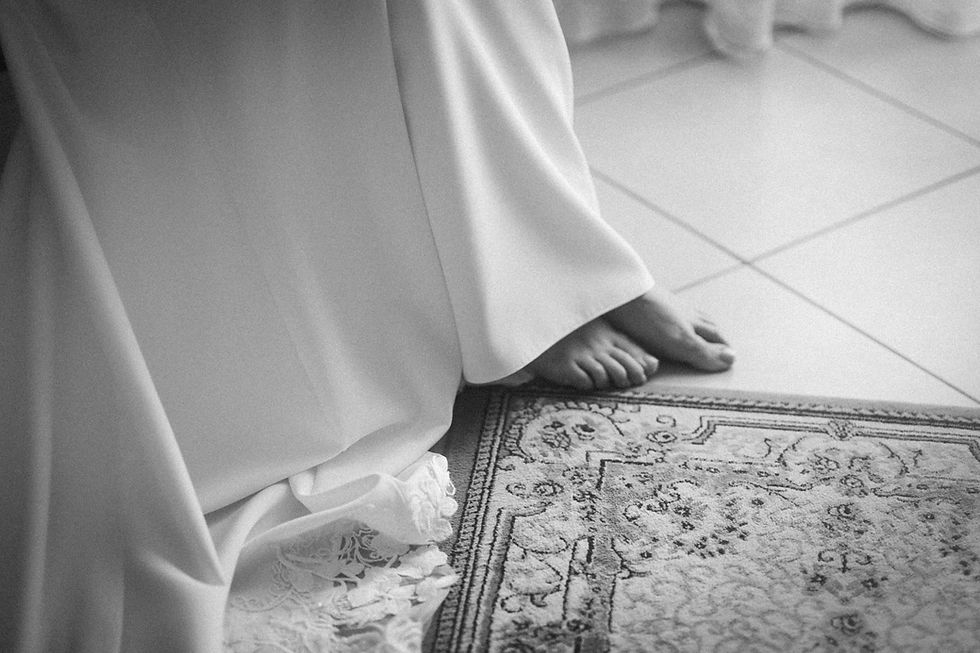
You have no idea how many people look at me weirdly when they notice that I often photograph people's feet. With or without shoes, posed or completely natural. Some have even explicitly asked me, "Don't photograph my feet." As I said, feet are a formidable expressive tool, but there’s more: they say a lot about the state of mind of the person I’m framing. Several official studies have explored this aspect, which falls under a specific branch of psychology: proxemics, the study of human non-verbal body language.




The proxemics of feet
Many experts (like Joe Navarro, former FBI agent) confirm that feet are the most "honest" part of the body. Being the furthest from the brain, they are much less subject to our conscious control than, say, facial expressions. For millennia, our survival depended on them (running from a predator or running toward food). If we want to escape a boring conversation, our feet point to the exit long before our mouth finds a polite excuse to leave. If someone is attracted to someone else, they tend to move their feet into an open position or "play" with their shoes. Conversely, crossing legs or hiding feet under a chair is a clear sign of closure.


Who is Drimage's photographer?
I'm Simona Turano: a professional photographer for over ten years, working throughout Italy and Europe, not only on weddings but also on creative projects focused on portraits. My education began at the Art School, progressed through the Academy of Fine Arts, and continued throughout Italy through countless specialized courses with the world's best professionals. I've been an illustrator and published several novels. Today, I also hold a qualification as a sommelier and am the only photographer in Italy with professional training as a Wedding Planner and Designer.

And do you ever think about what your feet are doing?
Don't be left stranded!


Comments